

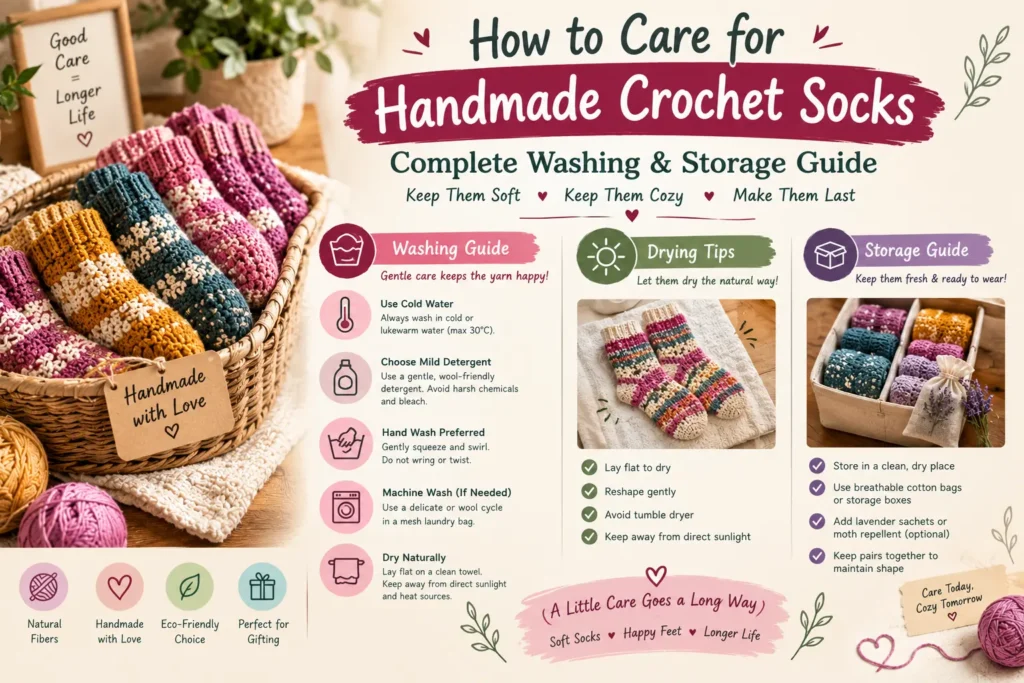
You have finally made the switch to handmade crochet socks — and the difference is everything you hoped for. The warmth, the softness, the perfect fit. Now comes the question that every new owner of handmade yarn products eventually asks: how do I keep them this good?
The answer is simpler than you might think. Handmade crochet socks are not fragile — they are made to be worn, loved, and used regularly. They just need a little different care than the synthetic machine-made socks you might have been washing without thinking about. With the right approach to washing, drying, and storing your crochet socks, they will stay beautiful, warm, and perfectly shaped for years — sometimes even decades.
At Gopi Handicraft, we pour genuine skill and care into every pair of socks we make. We want the people who receive them to enjoy them for as long as possible. This complete care guide tells you exactly how to do that.
Why Crochet Socks Need Different Care
Before the how-to, it helps to understand why handmade crochet socks need different care from machine-made ones:
They Are Made from Natural Fibres
Most handmade crochet socks use wool, cotton, bamboo, or blends of these natural fibres. Natural fibres respond differently to heat, agitation, and moisture than synthetic fibres do. Wool in particular can felt — permanently matting and shrinking — if exposed to hot water or rough agitation.
The Yarn Structure Can Be Affected by Rough Treatment
The interlocked loop structure of crochet fabric is resilient but not invulnerable. Aggressive wringing, tumbling in a dryer, or harsh scrubbing can distort the stitch structure over time, stretching or misshaping the sock.
They Were Shaped by Hand
A handmade sock was crafted to a specific shape — heel, toe, cuff — that was created by a person, not a machine. Proper drying and storage preserves this shape. Careless drying can gradually distort it.
Understanding these three factors makes the care instructions that follow not just rules to follow but genuinely logical steps that make complete sense once you know why they matter.
The Complete Washing Guide
Step 1: Check the Yarn Type First
Different yarns need slightly different washing approaches. If you ordered your socks from Gopi Handicraft, refer to the care note included with your order. If you are unsure, use the gentlest approach — hand washing in cool water — which works safely for all yarn types.
Cotton and bamboo socks: The easiest to care for. Hand wash in cool to slightly warm water. More forgiving of occasional gentle machine washing on a delicate cycle.
Wool and merino wool socks: Require the most care. Always hand wash in cool water only. Never machine wash, never use hot water.
Wool-acrylic blend socks: More durable than pure wool. Hand wash is still recommended, but a delicate machine cycle at 30°C is usually tolerated without damage.
Acrylic socks: The most durable and forgiving. Can typically handle a gentle machine cycle, but hand washing extends their life significantly.
Step 2: Prepare Your Washing Water
Fill a clean basin or sink with cool or lukewarm water — never hot. The temperature of the water is the single most important variable in washing handmade socks. Hot water is the most common cause of wool shrinkage and felting — damage that is permanent and irreversible.
Add a small amount of gentle washing product. The best options:
- Wool wash or Woolite — designed specifically for delicate wool fibres
- Baby shampoo — gentle, pH-balanced, and excellent for all natural yarns
- Mild hand soap — acceptable in small quantities if specialist products are unavailable
- Avoid: Regular laundry detergent (too harsh for natural fibres), biological detergents (enzymes can break down protein fibres like wool), fabric softener (can coat fibres and reduce absorbency)
Step 3: Wash Gently
Turn the socks inside out before placing them in the water — washing inside out reduces surface wear on the outer decorative surface and keeps colours brighter for longer.
Submerge the socks and gently work the soapy water through the yarn with your hands. Use a gentle pressing and squeezing motion — imagine gently massaging the fabric rather than scrubbing or wringing it.
Pay particular attention to:
- The sole — the area of highest wear and dirt accumulation
- The heel — particularly if reinforced, this area may need slightly more attention
- Around the cuff — sweat and skin oils accumulate here
Allow to soak for 5–10 minutes in the soapy water if particularly soiled.
Step 4: Rinse Thoroughly
Drain the soapy water and refill with clean cool water. Gently press and squeeze the socks to work the rinse water through — never pour water directly onto the socks in a strong stream, as this can felt wool fibres through agitation.
Rinse at least twice — until the water runs completely clear and no suds remain. Soap residue left in the yarn can make the fibres stiff over time and may irritate sensitive skin.
Step 5: Remove Excess Water — Never Wring
This step is critical and one of the most common mistakes people make. Never wring, twist, or squeeze crochet socks forcefully to remove water. Wringing distorts the stitch structure, stretches the yarn, and can permanently misshape the sock.
Instead:
- Lift the socks from the rinse water and gently cup them in your hands
- Press gently — do not squeeze — to remove the largest amount of water
- Lay the socks flat on a clean, dry towel
- Roll the towel up with the socks inside — like rolling a yoga mat — and press firmly but gently along the length of the roll
- Unroll the towel — the socks will have released a significant amount of water into the towel
Step 6: Reshape While Damp
This is the most important step for preserving the shape of your handmade socks — and the most often skipped.
While the socks are still damp from towel pressing, lay them flat and gently reshape them to their correct dimensions:
- Smooth the foot flat and align the toe seam correctly
- Stretch the cuff gently to its correct opening width
- Shape the heel to its correct curve
- For striped socks, ensure the stripes are lying straight and even
The yarn will dry in exactly the shape you leave it — so taking 30 seconds to reshape while damp means the socks will look perfectly made when dry.
The Complete Drying Guide
Dry Flat — Always
Never hang wet crochet socks to dry. Hanging causes the weight of the water-saturated yarn to pull downward, stretching the sock significantly — particularly at the cuff and the body of the sock. A sock that was made to your exact foot size can stretch to become loose and ill-fitting if consistently hung to dry.
Always dry flat on a clean, dry towel or on a flat drying rack.
Dry Away from Direct Heat
Never dry crochet socks on a radiator, in direct sunlight, or in a tumble dryer. Direct heat:
- Can shrink wool fibres (a process called felting that is irreversible)
- Can fade yarn colours unevenly
- Can cause some yarns to become brittle over time
- Can weaken the elastic properties of the yarn structure
Dry in a well-ventilated room at ambient temperature, or near (but not directly on or in front of) a gentle heat source.
Allow Complete Drying Before Wearing or Storing
This sounds obvious but is commonly neglected. Storing or wearing slightly damp socks encourages mould and mildew development in the yarn — a problem that can be difficult to resolve once it occurs.
Thick wool socks in particular can feel dry on the surface while still holding moisture inside the yarn layers. Squeeze gently before storing to check for any remaining dampness. When in doubt, allow an additional few hours of drying time.
Typical drying times for handmade crochet socks:
- Cotton ankle socks: 4–6 hours
- Wool ankle socks: 6–10 hours
- Thick wool mid-calf socks: 10–16 hours
- Knee-high wool socks: 12–20 hours
The Complete Storage Guide
Store Clean — Always
Never store handmade socks when dirty or even lightly soiled. Stains set more permanently over time, and any organic matter (sweat, skin oils) left in natural yarn fibres can attract moths and other pests. Always wash before storing for any extended period.
Store in Breathable Containers
Natural yarn fibres need to breathe during storage. Sealed plastic bags or airtight containers trap moisture and can encourage mildew — even in socks that feel completely dry.
Best storage options:
- Cotton drawstring bags
- Open-weave mesh bags
- Fabric-lined baskets
- Breathable fabric storage boxes
- Clean cardboard boxes
Protect Wool Socks from Moths
This is a consideration specific to wool socks — and an important one. Wool is a protein fibre that moth larvae feed on. If you store wool socks for extended periods (between seasons), take precautions:
- Cedar balls or cedar blocks — natural moth deterrent, safe for all fabrics
- Lavender sachets — natural deterrent with a beautiful scent
- Dried cloves or rosemary — natural alternatives to chemical moth repellents
- Sealed bags for seasonal storage only — for short-term (1–2 month) seasonal storage, sealed bags with a cedar ball inside are acceptable
Avoid chemical moth balls — they are toxic and leave a persistent smell that is difficult to remove from yarn.
Store Flat, Not Hanging
Storing socks hanging — particularly heavier wool socks — can stretch the cuff over time. Fold or roll socks flat for storage.
The gentle roll method: Lay one sock flat, place the second sock on top aligned exactly, then roll from toe to cuff into a loose roll. Store rolls in your storage container or drawer. This method keeps pairs together without compressing or stretching the fibres.
Seasonal Storage Between Winters
If you wear your wool crochet socks only in winter, store them correctly between seasons:
- Wash thoroughly and dry completely
- Add lavender or cedar to the storage container
- Store in a breathable cotton bag inside a cool, dry drawer or box
- Check once mid-season to ensure no moisture or pest issues have developed
Troubleshooting Common Crochet Sock Problems
Problem: My wool socks shrunk in the wash
Cause: Hot water or agitation
Solution: Unfortunately shrinkage from felting is permanent and cannot be fully reversed. You can try gently stretching the still-damp socks back toward their original size and drying flat — this sometimes partially recovers the shape. Prevention is the only true solution: always cold water, always gentle.
Problem: My socks have stretched out of shape
Cause: Hanging to dry or aggressive wringing
Solution: Wash again in cool water, reshape carefully while damp, and dry flat. Repeatedly reshaping while damp can gradually restore a stretched sock close to its original dimensions.
Problem: A yarn loop has been caught and pulled
Cause: Contact with a sharp edge, hook, or rough surface
Solution: Do not pull the snagged loop further. Instead, gently ease the loop back into position by working the slack back through the surrounding stitches from both sides of the snag. Use a blunt yarn needle if needed. If the loop has been pulled entirely out of the fabric, contact us for repair advice.
Problem: My socks smell musty after storage
Cause: Stored before completely dry, or in a sealed container
Solution: Air the socks outdoors in fresh air (in the shade) for several hours. Then hand wash with a gentle wool wash, reshape, and dry completely before returning to proper breathable storage.
Problem: Colours have faded
Cause: Washing in warm or hot water, or extended sun exposure during drying
Solution: Colour fading cannot be reversed. Prevent further fading by washing in cold water and drying away from direct sunlight. Dark colours fade faster than light ones — this is normal and expected over years of wear.
Problem: Pilling on the surface
Cause: Normal wear and friction — particularly on the sole and heel
Solution: Use a fabric de-pilling comb or a lint roller designed for knitwear to gently remove pills from the surface. This is normal with all yarn products and does not affect the structural integrity of the sock.
How Often Should You Wash Crochet Socks?
This is a question more people should ask — because overwashing is one of the main causes of premature wear in handmade yarn products.
Wool socks: Wool has natural antibacterial and odour-resistant properties — it can typically be worn 2–3 times before washing, or aired between wears. Air overnight on a flat surface between wears to refresh.
Cotton and bamboo socks: Should be washed after every 1–2 wears, as cotton holds moisture and benefits from more frequent cleaning.
Acrylic blend socks: Wash after every 1–2 wears. Acrylic does not have wool’s natural self-cleaning properties.
Baby socks: Wash after every single wear — hygiene is paramount for baby items.
Quick Reference Care Chart
| Yarn Type | Wash Method | Water Temp | Dryer Safe? | Dry Method | Wash Frequency |
|---|---|---|---|---|---|
| Pure wool | Hand wash only | Cool (20°C) | Never | Flat, no heat | Every 2–3 wears |
| Merino wool | Hand wash only | Cool (20°C) | Never | Flat, no heat | Every 2–3 wears |
| Bamboo-wool | Hand wash preferred | Cool (25°C) | Never | Flat, no heat | Every 1–2 wears |
| Cotton | Hand wash or delicate machine | Cool-lukewarm (30°C) | No | Flat, low heat | Every 1–2 wears |
| Acrylic | Hand wash preferred | Lukewarm (30°C) | No | Flat, low heat | Every 1–2 wears |
| Baby cotton/bamboo | Hand wash only | Cool (20°C) | Never | Flat, no heat | After every wear |
Frequently Asked Questions
We strongly recommend against machine washing wool crochet socks — the agitation and heat risk felting and shrinkage. Cotton and acrylic socks can tolerate a gentle delicate cycle at 30°C, but hand washing significantly extends their life.
Immediately soak in cool water, then very gently stretch back toward the original shape while the wool is still wet and pliable. Dry flat in the stretched position. This can partially recover the shape but cannot fully reverse felting. Always wash by hand going forward.
For fresh stains, rinse immediately with cool water — do not rub. Apply a tiny drop of mild soap directly to the stain, work in gently with your fingers, and rinse. For set stains, soak in cool water with a gentle stain treatment safe for delicate fabrics.
No — tumble drying is not recommended for any handmade crochet socks. The heat can shrink wool, and the tumbling can distort the stitch structure of all yarn types. Always air dry flat.
Store clean, dry wool socks with cedar balls or lavender sachets in a breathable cotton bag. Avoid sealed plastic bags for long-term storage. Check stored socks monthly during long storage periods.
Shop our full crochet sock collection at gopihandicraft.com or find us on Amazon and Meesho for fast delivery across India.
Final Thoughts
Your handmade crochet socks were made with hours of skill, care, and genuine craft. The care they need in return is modest — cool water, gentle handling, flat drying, and breathable storage. That is the full extent of what they ask of you.
Follow these steps consistently and your socks will reward you with years — sometimes even decades — of warmth, softness, and the quiet pleasure of something genuinely well-made. They will become the socks you reach for first on cold mornings, the ones that feel most like home on your feet.
At Gopi Handicraft, we make every pair knowing it deserves to be loved for a long time. This care guide is our way of making sure that happens.
Shop our handmade crochet socks — and wear them well.
Written by Gopi Handicraft | Handmade with Love from Surat, Gujarat 🧶