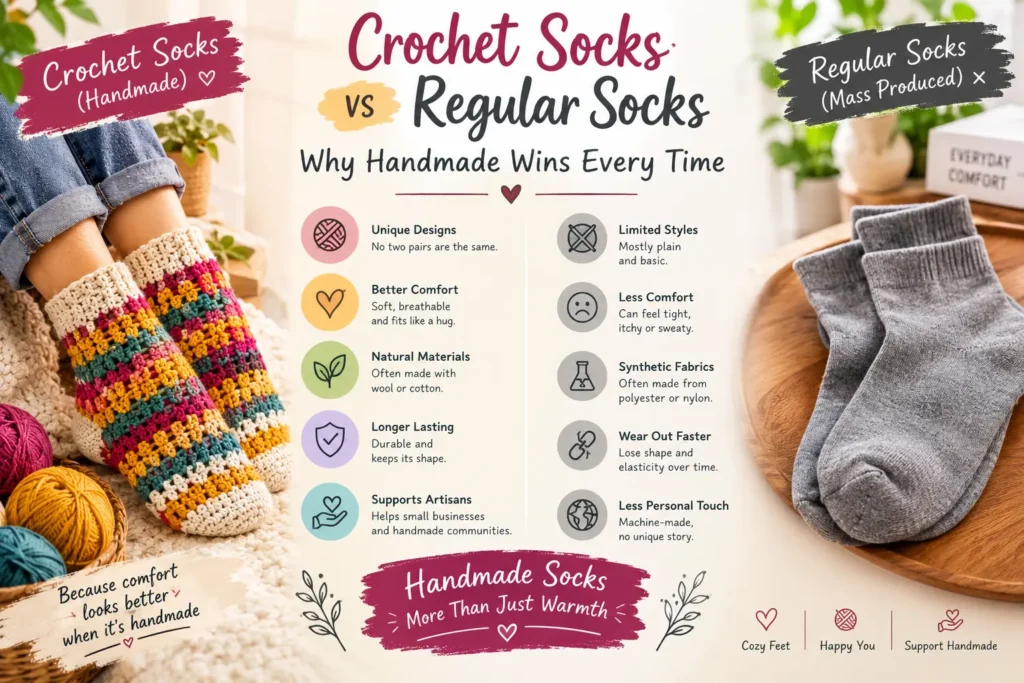
Most of us have never given much thought to our socks. They go in the drawer, they come out in the morning, they disappear in the wash, and they develop holes within a few months. The entire experience of the average machine-made sock is forgettable at best and frustrating at worst.
Then someone gives you a pair of genuinely handmade crochet socks. And everything changes.
The difference is immediate and physical — the softness, the weight, the way they fit your foot rather than some standardised version of a foot. And the difference only deepens over time: the warmth on a cold night, the way they hold their shape after washing, the fact that six months later you are still reaching for them first.
In this complete comparison, we break down every important factor — warmth, comfort, fit, durability, style, sustainability, and value — to answer the question definitively: crochet socks vs regular socks — which is actually better?
What We Are Comparing
Handmade Crochet Socks
Socks made entirely by hand using a crochet hook and quality yarn — wool, cotton, bamboo, or blend. Made stitch by stitch, sized to the actual wearer’s foot measurements, and finished by hand. Every pair is unique.
Regular Machine-Made Socks
Socks produced by industrial knitting machines in standardised sizes — typically in synthetic materials, cotton blends, or acrylic. Available everywhere, produced in millions of identical pairs, and designed to a price point rather than a quality point.
The Full Head-to-Head Comparison
| Factor | Handmade Crochet Socks | Regular Machine-Made Socks |
|---|---|---|
| Warmth | Exceptional — thick yarn, dense stitching | Variable — often insufficient in real cold |
| Softness | Very soft — quality yarn, no synthetics | Often scratchy — especially cheaper varieties |
| Fit | Custom to your actual foot size | Generic S/M/L — often too tight or loose |
| Durability | Long-lasting — years with proper care | Typically 3–6 months before holes appear |
| Breathability | Good — natural fibre yarn | Poor — synthetic fibres trap moisture |
| Moisture management | Excellent — wool wicks and regulates | Poor to moderate — synthetic holds moisture |
| Shape retention | Holds shape well with care | Loses shape quickly — elastic wears out |
| Uniqueness | Every pair handmade and different | Millions of identical pairs |
| Eco-friendly | Low impact — natural materials, small batch | High impact — synthetic production, fast disposal |
| Gifting appeal | Very high — personal and handmade | Very low — generic and impersonal |
| Price | Reflects genuine artisan skill | Cheap to moderate |
| Value over time | Excellent — cost per wear is very low | Poor — replaced frequently |
| Story | Made by a real person who cared | Made by a machine |
| Custom options | Yes — any size, colour, length | No — what is in the packet is what you get |
Round-by-Round: The Honest Verdict
Round 1 — Warmth: Handmade Wins Decisively
This is the most critical factor for most people buying socks in India — particularly in the north during winter, on hill station trips, and in the early mornings and late evenings across the country from November to February.
The warmth comparison is not even close.
A machine-made sock — even one marketed as “warm” or “woollen” — is typically made from a thin yarn on a tight machine gauge, producing a sock with limited insulating capacity. Many “woollen” commercial socks contain only a small percentage of actual wool, with the rest being synthetic fibres that do not insulate.
A handmade crochet sock uses substantially more yarn — thicker, higher-quality yarn worked at a gauge that creates genuine insulating depth. The air trapped between the thick yarn fibres is what creates warmth, and a handmade crochet sock simply traps more of it.
In practical terms: on a cold Shimla morning or a winter night in Delhi, a handmade wool crochet sock will keep your feet genuinely, significantly warmer than a regular machine-made sock of the same stated size.
Verdict: Handmade crochet socks win — not marginally, but substantially.
Round 2 — Softness and Comfort: Handmade Wins
Here is a truth about most inexpensive machine-made socks: they are made from yarn that was chosen for its price, not its feel. Synthetic fibres, rough cotton blends, and chemical finishes create socks that feel acceptable in the shop and become increasingly scratchy and uncomfortable with every wash.
A handmade crochet sock is made from yarn specifically chosen for its quality and feel — soft wool, bamboo, or quality cotton that starts soft and stays soft wash after wash. The crafter who makes your socks chooses the yarn with the understanding that it will be against someone’s skin all day — a consideration that industrial production does not make.
Beyond the yarn quality, the construction matters too. A handmade sock has no seams in the wrong places, no tight elastic band that digs in, and no stitching that creates pressure points. It fits like a second skin because it was made for skin.
Verdict: Handmade crochet socks win — the difference is felt immediately.
Round 3 — Fit: Handmade Wins Completely
This is perhaps the most clear-cut advantage of handmade socks, and the one that surprises people most when they experience it for the first time.
Machine-made socks come in S, M, L — or worse, “one size fits all.” These sizes cover a range of feet with an average that fits nobody perfectly. Too tight across the ball of the foot for some, too loose at the heel for others, too short for longer feet, too long for smaller ones.
A handmade crochet sock is made to your actual foot measurements — length, width, arch height, and whatever other specific requirements you have. The result is a sock that fits your foot the way a quality shoe is supposed to fit — with no excess, no shortage, no pressure, and no slipping.
For people with non-standard foot shapes — wider feet, longer toes, high arches — a custom handmade sock is not just better but genuinely transformative.
Verdict: Handmade crochet socks win — custom fit versus generic sizing is no contest.
Round 4 — Durability: Handmade Wins in the Long Run
Most machine-made socks develop holes within three to six months of regular wear — particularly at the heel and the ball of the foot, where friction is highest. The thin yarn used in machine production wears through quickly, and the tight machine gauge does not allow for the kind of yarn distribution that creates durability.
A well-made crochet sock is significantly more durable. The thicker yarn has more material to wear through before developing holes. The handmade construction allows the maker to reinforce high-wear areas — heels, toes, and balls of feet — with additional yarn layers. And because the sock was made with care, attention was paid to exactly these durability details.
With proper care — hand washing, flat drying — a quality handmade crochet sock can last for several years of regular wear. The cost per wear, calculated over the life of the sock, is often lower than that of cheap machine-made socks that need replacing every few months.
Verdict: Handmade crochet socks win — significantly better long-term value.
Round 5 — Breathability and Moisture Management: Handmade Wins
Synthetic socks — polyester, nylon, acrylic — trap moisture against the skin. Feet sweat throughout the day, and a synthetic sock holds that moisture next to the skin, creating discomfort, odour, and in prolonged cases, skin irritation or fungal issues.
Natural fibre yarn — wool, cotton, bamboo — manages moisture entirely differently. Wool actively wicks moisture away from the skin and into the yarn fibre, where it can evaporate, while simultaneously maintaining the insulating properties that keep feet warm even when damp. Cotton absorbs moisture and feels soft. Bamboo is naturally antibacterial as well as moisture-wicking.
A handmade crochet sock in natural fibre yarn keeps feet drier, fresher, and healthier throughout the day than any synthetic machine-made alternative.
Verdict: Handmade crochet socks in natural yarn win — especially for all-day wear.
Round 6 — Style and Personality: Handmade Wins
A machine-made sock comes in the colours and patterns the manufacturer decided to produce — limited choices, seasonal availability, and the knowledge that thousands of other people are wearing exactly the same design.
A handmade crochet sock can be made in any colour, any stripe combination, any pattern that exists in crochet. Want socks that exactly match your favourite outfit? Done. Want socks in your child’s favourite colours? Done. Want a pair of socks with a small crocheted charm at the ankle? Done.
The personalisation possibilities of handmade socks are essentially unlimited — and in an era where personal expression in fashion has never mattered more, this is a significant and underappreciated advantage.
Verdict: Handmade crochet socks win — no comparison on personalisation and style.
Round 7 — Price: Machine-Made Socks Win Upfront
This is the one honest area where regular socks have an advantage — the upfront purchase price. Machine-made socks are cheap because they are produced at enormous scale with minimal labour cost. Handmade socks cost more because a skilled artisan’s time, skill, and quality materials went into making them.
However — and this is important — the price comparison looks very different when calculated over the life of the sock. A ₹50 machine-made sock that lasts 4 months costs ₹150 per year. A handmade crochet sock that lasts 3 years represents a significantly lower cost per year of use, even at a higher upfront price.
Verdict: Machine-made socks win on upfront price. Handmade wins on long-term value.
Round 8 — Sustainability: Handmade Wins Clearly
The environmental impact of the global fast fashion industry — which includes the enormous sock manufacturing sector — is substantial. Synthetic fibre production uses petroleum derivatives. Industrial dyeing uses enormous amounts of water and chemicals. Mass production creates significant waste from unsold stock.
Handmade crochet socks use natural yarn (or quality acrylic), are made in small batches or to order with minimal waste, and last long enough to stay out of landfill for years. The environmental footprint of a pair of handmade socks is a fraction of that of disposable fast fashion socks.
Verdict: Handmade crochet socks win — significantly better for the planet.
The Scorecard
| Factor | Winner |
|---|---|
| Warmth | ✅ Handmade crochet socks |
| Softness and comfort | ✅ Handmade crochet socks |
| Fit | ✅ Handmade crochet socks |
| Durability | ✅ Handmade crochet socks |
| Breathability | ✅ Handmade crochet socks |
| Style and personalisation | ✅ Handmade crochet socks |
| Upfront price | ✅ Regular machine-made socks |
| Long-term value | ✅ Handmade crochet socks |
| Sustainability | ✅ Handmade crochet socks |
| Overall | ✅ Handmade crochet socks — 8 to 1 |
When Regular Socks Still Make Sense
In the spirit of complete honesty — here are the scenarios where regular machine-made socks remain a sensible choice:
- Sports and athletic use — technical sports socks with engineered compression zones, arch support, and performance features are genuinely difficult to replicate in handmade crochet. For running, gym training, or intensive sports, a technical machine-made sports sock may serve better.
- Very large quantity needs — if you need twenty pairs of identical socks for a school uniform or a team, handmade is not the practical choice.
- Disposable needs — if you need cheap socks for a single occasion and have no long-term use in mind, the economics of handmade do not apply.
Outside these specific scenarios, handmade crochet socks win — on every factor that actually matters for real, daily foot comfort.
Making the Switch: How to Transition to Handmade Socks
If you have always worn machine-made socks and want to make the transition to handmade, here is a practical approach:
Start with one pair — replace your most-worn everyday sock with a handmade pair. Wear them daily for two weeks and notice the difference in warmth, fit, and comfort.
Gift them first — give a pair as a gift. The recipient’s reaction will tell you everything you need to know about how special they are.
Buy for a specific need — cold nights, a hill station trip, a new baby — occasions where the advantages of handmade are most immediately felt are the perfect starting points.
Invest in winter first — the warmth advantage of wool crochet socks in winter is the most dramatic and immediately convincing quality difference. A pair of handmade wool socks on a cold Delhi night is a genuinely convincing argument for handmade.
Frequently Asked Questions
Yes — significantly. Handmade crochet socks made from wool or quality yarn use more material, thicker construction, and natural insulating fibres that create genuine warmth far beyond what most machine-made socks can provide.
Handmade crochet socks cost more upfront than budget machine-made socks — but they last significantly longer and provide significantly better comfort. The cost per year of use is often comparable or better than replacing cheap socks every few months.
Wool yarn socks can shrink if washed in hot water or put in a dryer. Always hand wash in cool water and lay flat to dry. Cotton and bamboo crochet socks are more stable and less prone to shrinking.
Yes — at Gopi Handicraft, we make socks to your specific foot measurements. This is one of the most important advantages of handmade socks. Contact us through gopihandicraft.com with your foot length and width.
Handmade socks in soft natural yarn — particularly bamboo or fine merino wool — can be an excellent choice for people with sensitive feet, as they have no tight elastic, no synthetic fibres, and no rough seams. However, always consult a healthcare professional for specific medical sock recommendations.
Shop our handmade crochet socks at gopihandicraft.com or find us on Amazon and Meesho for fast delivery across India.
Final Thoughts
The comparison between handmade crochet socks and regular machine-made socks is not really close — not when you consider warmth, comfort, fit, durability, and value over time. The only advantage regular socks have is a lower upfront price, and even that advantage disappears when you calculate how many pairs of cheap socks you replace in the time one pair of handmade socks lasts.
The real question is not “are handmade socks better?” — they clearly are. The question is: “why did I wait this long to try them?”
At Gopi Handicraft, we make handmade crochet socks with the same love, skill, and attention to detail that goes into every piece we create. We want your feet to be genuinely warm, genuinely comfortable, and genuinely happy.
Make the switch to handmade socks today.
👉 Shop Handmade Crochet Socks at gopihandicraft.com
Written by Gopi Handicraft | Handmade with Love from Surat, Gujarat 🧶