If you have ever held a handmade crochet toy, admired a beautifully crafted crochet bag, or received a handmade woolly gift — you may have wondered: is this crocheted or knitted?
Most people use the terms interchangeably. But crochet and knitting are actually two entirely distinct crafts — with different tools, different techniques, different textures, and different strengths. Understanding the difference not only helps you appreciate handmade items more deeply, but also helps you make more informed choices when buying or gifting handmade products.
At Gopi Handicraft, everything we make is crocheted — not knitted. In this article, we break down exactly what that means, how crochet and knitting differ, and why crochet is particularly well-suited to the beautiful products we create.
The Simple Answer: What Is the Difference?
At the most basic level:
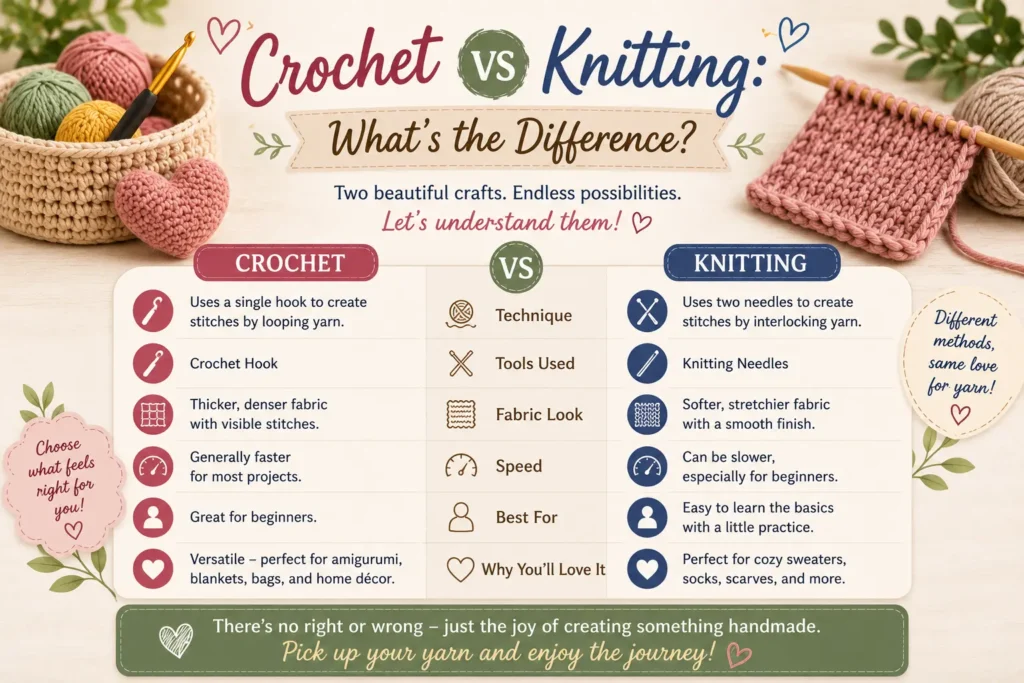
- Knitting uses two needles and creates fabric by working multiple loops simultaneously — loops pass through each other in a complex, interconnected way
- Crochet uses one hook and creates fabric one stitch at a time — each stitch is completed individually before the next one begins
This fundamental difference in technique leads to very different results in the finished fabric, the types of items that can be made, and the experience of making them.
What Is Crochet?
Crochet (pronounced kroh-SHAY) comes from the French word crochet, meaning “small hook.” It is a method of creating fabric by interlocking loops of yarn using a single hooked needle.
In crochet, only one loop is active at any time — each stitch is completed fully before moving to the next. This gives crochet fabric a distinctive, textured appearance and makes crochet particularly versatile for three-dimensional shapes — which is why it excels at making toys, bags, accessories, and decorative items.
In Hindi/Urdu, crochet is sometimes called krosha (क्रोशे) — a word familiar to many Indian women who learned the craft from older generations.
Key characteristics of crochet:
- Uses a single hook (not two needles)
- One active stitch at a time
- Creates a thicker, more textured fabric
- Excellent for 3D shapes and sculptural work
- Uses approximately 30% more yarn than knitting for the same area
- Generally easier for beginners to learn
- Cannot be done on a machine — true crochet is always handmade


As an Amazon Associate, Gopi Handicraft earns from qualifying purchases.
What Is Knitting?
Knitting is a method of creating fabric by interlocking loops of yarn using two or more needles. In knitting, multiple loops are active simultaneously — they sit on the needles and are worked through each other row by row.
Knitting creates a smoother, more elastic fabric than crochet. It is particularly well-suited to flat fabric construction — garments like sweaters, scarves, socks, and blankets. The resulting fabric drapes more softly and stretches more easily than crochet fabric.
Key characteristics of knitting:
- Uses two or more needles
- Multiple active stitches at once
- Creates a smoother, more draping fabric
- Excellent for flat garments and stretchy items
- Uses slightly less yarn than crochet
- Has a steeper learning curve for beginners
- Can be machine-replicated — many “knitted” items are machine-made


As an Amazon Associate, Gopi Handicraft earns from qualifying purchases.
Crochet vs Knitting: Full Comparison
| Factor | Crochet | Knitting |
|---|---|---|
| Tool | Single hook | Two or more needles |
| Active stitches | One at a time | Many at once |
| Fabric texture | Thicker, more textured | Smoother, more elastic |
| Learning curve | Generally easier for beginners | Steeper learning curve |
| 3D shapes | Excellent — ideal for toys, bags | Difficult — not well suited |
| Flat fabric / garments | Good | Excellent — ideal for sweaters, socks |
| Yarn usage | ~30% more than knitting | More economical |
| Machine replication | Cannot be truly machine crocheted | Can be machine knitted |
| Undo-ability | Easy to unravel and redo | Trickier to undo without losing work |
| Speed | Generally faster stitch-by-stitch | Can be faster for flat fabric |
| Versatility for accessories | Very high | Moderate |
| Authentically handmade | Always | Often machine-made in commercial products |
Why True Crochet Cannot Be Machine-Made
This is one of the most important distinctions — and one that matters deeply to us at Gopi Handicraft.
Knitting can be replicated by machine. Industrial knitting machines can produce knitted fabric at enormous speed, which is why many commercial “knitted” products (sweaters, scarves, socks) are actually machine-made despite appearing handcrafted.
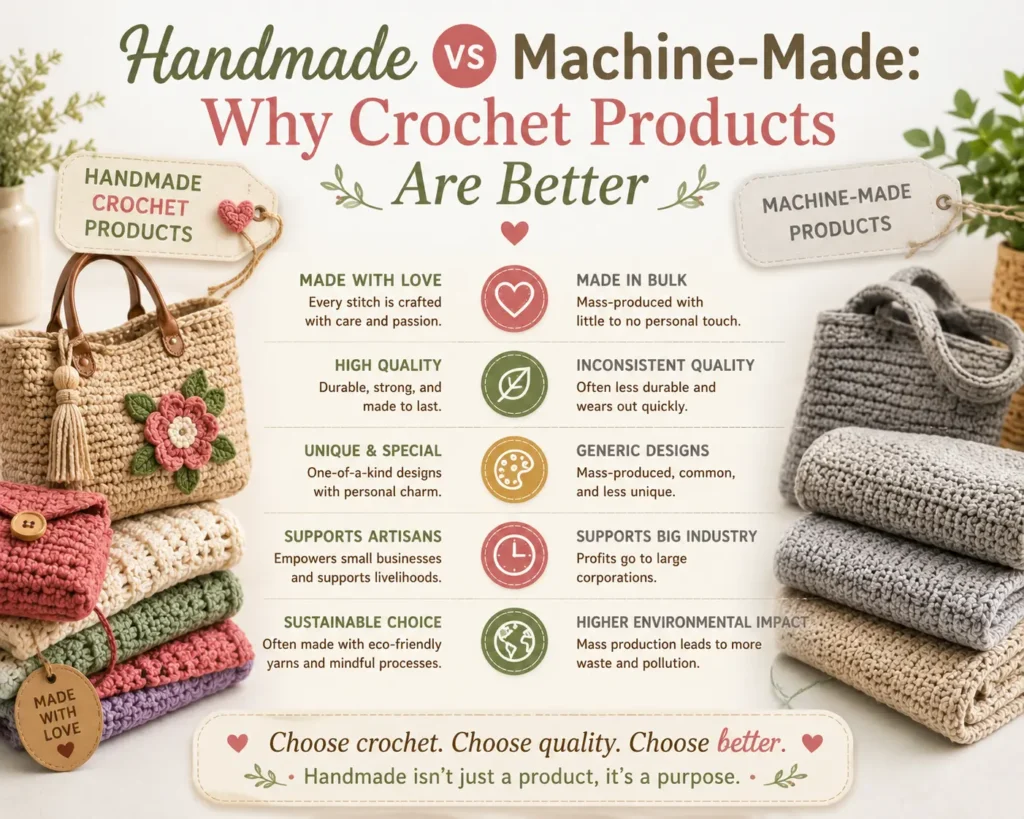
True crochet, however, cannot be replicated by machine. The fundamental technique of crochet — where a hook pulls yarn through a single active loop at a time — cannot be mechanically reproduced. Every genuine crochet item you encounter has been made by human hands.
This is why when you buy a crochet product from Gopi Handicraft, you can be absolutely certain it is handmade. Not hand-finished after machine production. Not assembled from machine-made components. Genuinely, stitch by stitch, made by human hands.
How to Tell Crochet from Knitting by Looking
Once you know what to look for, crochet and knitting are visually quite distinct:
Crochet Looks Like:
- V-shapes and chains — crochet stitches often form visible V-shaped or chain-link patterns
- Thicker and more textured — crochet fabric has more visible individual stitches
- Defined stitch structure — each stitch is clearly identifiable
- Denser fabric — less drape, more structure
- Sculptural capability — three-dimensional shapes and rounded forms (like amigurumi) indicate crochet
Knitting Looks Like:
- V-shapes in rows — knitting creates a distinctive, regular V-pattern in the fabric
- Smoother and more uniform — the surface is more even and less textured
- More stretch — knitted fabric stretches significantly in multiple directions
- Softer drape — falls and flows more softly than crochet
- Flat construction — most knitted items are flat panels sewn together
What Each Craft Is Best At
Crochet Excels At:
- 3D amigurumi toys — the most iconic crochet application; impossible to achieve in knitting
- Bags and accessories — the structured, textured fabric is ideal for bags, phone holders, and pouches
- Home decor — flower pot arrangements, decorative elements, and textured home accessories
- Keychains and bag charms — small, detailed 3D objects require crochet’s stitch-by-stitch control
- Lace and decorative edging — intricate openwork patterns are easier to achieve in crochet
- Quick projects — individual stitches complete faster, making crochet ideal for smaller items
Knitting Excels At:
- Sweaters and cardigans — smooth, elastic, draping fabric is ideal for garments
- Socks — the elasticity of knitted fabric makes it perfect for fitted socks
- Scarves and wraps — soft, flowing knitted fabric is wonderful for draping accessories
- Baby blankets — smooth, stretchy knitted blankets have a particularly soft feel
- Fine garments — delicate, form-fitting clothing works better in knitting
The Indian Connection: Crochet and Knitting in India
Both crochet and knitting have long traditions in India — though they arrived through different routes:
Knitting in India has deep roots in the northern hill regions — Kashmiri knitting traditions, Himalayan woollen crafts, and the famous Kullu shawls from Himachal Pradesh are all knitting-based traditions of great cultural significance.
Crochet in India was introduced during the colonial period and spread widely through domestic craft traditions — particularly in Gujarat, Rajasthan, and Maharashtra. Indian crochet developed its own distinctive aesthetic, incorporating traditional motifs, vibrant colours, and the natural creativity of Indian women who adopted and adapted the craft over generations.
Today, Gujarat is one of the strongest crochet craft regions in India — and it is in Gujarat, in the vibrant city of Surat, that Gopi Handicraft was born. Our crochet tradition is deeply rooted in this regional heritage.
Why Gopi Handicraft Chose Crochet
When we started Gopi Handicraft, we chose crochet for very specific reasons that align perfectly with our products and values:
1. True Handmade — Always
Because crochet cannot be machine-made, every product we create is genuinely, authentically handmade. There is no ambiguity, no grey area. Crochet means handmade — full stop.
2. Perfect for 3D Products
Our amigurumi toys, sunglass holders, phone pouches, and keychains all rely on crochet’s ability to create structured, three-dimensional shapes. Knitting simply cannot achieve these forms.
3. Textural Richness
Crochet’s distinctive texture — the visible stitch structure, the depth of the fabric — gives our bags, accessories, and decor a visual character that sets them apart.
4. Versatility
From tiny keychains to full-sized bags, from delicate hair accessories to structured bangles covers — crochet’s versatility across scales and applications makes it the perfect craft for a diverse product range.
5. Speed and Precision
Working one stitch at a time gives the maker precise control over every element of the design — particularly important for detailed work like amigurumi faces, flower petals, and decorative motifs.
Common Questions About Crochet and Knitting
Q: Is crochet easier than knitting? Most beginners find crochet easier to learn than knitting. With crochet, you only manage one active stitch at a time — there is no risk of dropping multiple stitches from a needle. The hook is also easier to hold and control than two needles for many people.
Q: Can the same yarn be used for both crochet and knitting? Yes — most yarn can be used for both crafts. The choice between crochet and knitting is about the tool and technique, not the yarn itself. That said, some yarns work better for one craft or the other depending on their weight, texture, and fibre content.
Q: Is crochet always handmade? True crochet, yes — the technique fundamentally requires a human hand to guide the hook. Machine-made items can replicate a crochet-like appearance, but they are not genuine crochet. This is why handmade crochet products like those from Gopi Handicraft carry a premium — they genuinely cannot be made any other way.
Q: What does “crochet” mean in Hindi? Crochet is commonly referred to as krosha (क्रोशे) in Hindi and Urdu — derived from the French word for hook. Many Indian women who learned crochet from older generations know it by this name.
Q: Can crochet be used to make clothing? Yes — crochet can be used to make clothing including tops, cardigans, skirts, and dresses. However, crochet garments tend to be thicker and less elastic than knitted ones, making knitting generally better suited to close-fitting garments. Crochet excels at accessories, toys, bags, and decorative items.
Q: How long does it take to learn crochet? Most people can learn the basic crochet chain stitch and single crochet within a few hours. Creating a simple small project like a coaster or basic keychain is achievable within a day for a motivated beginner. Developing true skill and confidence takes a few weeks to months of regular practice.
Q: Where can I buy authentic handmade crochet products in India? Shop our full collection of genuine handmade crochet products at gopihandicraft.com or find us on Amazon and Meesho for fast delivery across India.
Why Knowing the Difference Matters When You Shop
Understanding the difference between crochet and knitting helps you make better decisions when buying handmade products:
- If a seller claims their products are “crocheted” — they must be handmade, because true crochet cannot be machine-produced
- Machine-made “crochet-style” products are not genuine crochet — they are knitted or woven imitations of the crochet aesthetic
- Genuine crochet products are more labour-intensive to make, which is reflected in their price and quality
- When you pay for genuine handmade crochet, you are paying for something that genuinely cannot be made any other way — human skill, human time, and human care
At Gopi Handicraft, every product in our range is genuinely, authentically crocheted by hand. We are proud of this — and we want our customers to understand and appreciate exactly what that means.
Final Thoughts
Crochet and knitting are two distinct and beautiful crafts — each with its own unique qualities, techniques, and strengths. Understanding the difference helps you appreciate handmade products more deeply and make more informed choices when buying or gifting.
At Gopi Handicraft, we have chosen crochet because it is the perfect craft for everything we make — three-dimensional toys, structured bags, detailed accessories, and beautiful home decor. And because true crochet is always, without exception, made by human hands.
Explore our collection of authentic handmade crochet products today.
👉 Shop at gopihandicraft.com
Written by Gopi Handicraft | Handmade with Love from Surat, Gujarat 🧶